
 Seminar at SoftUni Creative
Last updated on
Has a client ever told you they found you “through ChatGPT”?
Or the opposite. You ask an AI assistant who does what you do in your market, and the answer names three competitors. You are not there.
Google now answers directly in the results with AI Overviews, and some buyers ask ChatGPT before they even open a search engine. The question is no longer only “what position are we in”. It is whether we get cited when someone asks about what we sell.
That is what SEO for AI Overviews and ChatGPT is about. There are no tricks that guarantee a place in AI answers. There are things that depend on you, and a way to check where you stand today. Below are both, with examples from our own website.
The short version
- AI Overviews and AI Mode pick their sources from pages Google has already indexed. If you are not visible in regular search, there is nothing to cite.
- According to Google, no special files or markup are needed. What is needed is content that gives a clear, verifiable answer.
- When Google shows an AI summary, people click through to websites almost half as often.
- ChatGPT search only shows sites that allow its crawler, OAI-SearchBot.
- Specific numbers, quotations and original data increase the chance that a page gets cited.
- AI visibility is tracked from three places: Search Console, GA4 and a manual check once a month.
What has changed in search
AI Overviews are the summaries Google shows above the results. AI Mode is a separate mode where people have a conversation with the search engine instead of scanning a list of links. ChatGPT, Gemini and Perplexity do something similar outside Google: they assemble an answer from several websites and show the sources next to it.
For a business, the change is simple. Some questions now get an answer without anyone reaching a website.
Pew Research Center tracked the real browsing behaviour of 900 people in the US in March 2025. When Google showed an AI summary, they clicked on a regular result in 8% of visits. Without a summary, the share was 15%. They clicked on a link inside the summary itself in just 1% of visits.
An Ahrefs analysis of 300,000 keywords reaches the same conclusion from another direction. For searches with an AI Overview, the click-through rate of the first position is 58% lower.
In practice, a page in first position that brought 100 clicks a month for an informational search may bring around 40 today with the same visibility. The position stays. The clicks do not.
Google says clicks after an AI summary are of higher quality and visitors stay longer. It is worth taking that with some caution, as it is Google’s own observation, not independent research.
| Where | What the buyer sees | Where the sources come from | Where to measure it |
|---|---|---|---|
| AI Overviews | A summary above the Google results | Google’s index | Search Console, the generative AI features view |
| AI Mode | A conversation with Google instead of a list of results | Google’s index | Search Console, the same view |
| ChatGPT search | An answer with sources in ChatGPT | Sites OAI-SearchBot can access | GA4, referrals from chatgpt.com |
| Perplexity, Gemini, Copilot | An answer with sources | Their own search or a partner search engine | GA4, referrals |
How AI decides which websites to cite
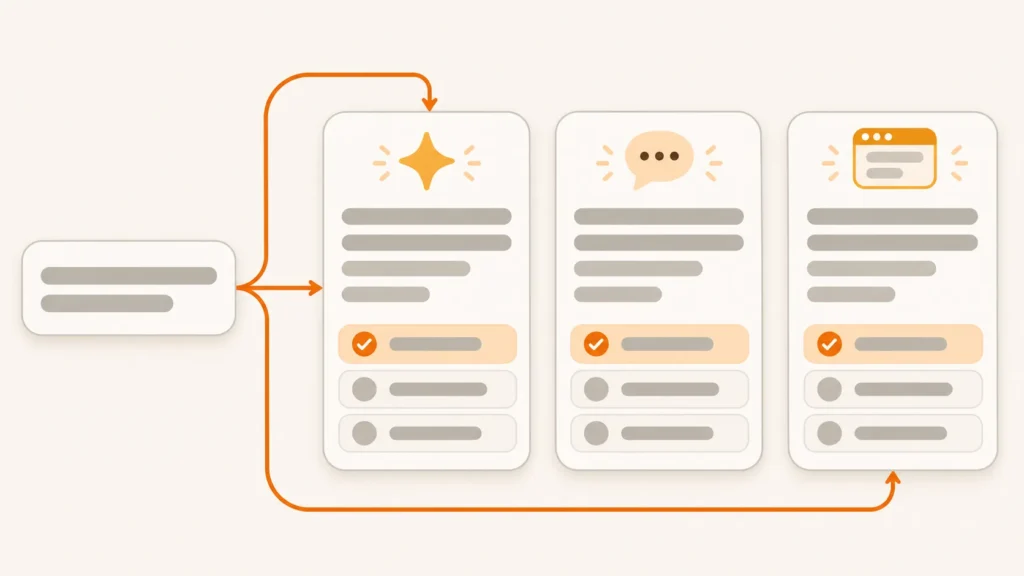
Google is clear. For AI Overviews and AI Mode, there are no additional requirements. A page has to be indexed and eligible to appear in search with a text snippet. No new machine-readable files, AI text files or special markup are needed.
In other words, the foundation is the same as in classic SEO. Beyond it, a few things make a page easier to cite.
A clear answer instead of general claims
An AI assistant looks for a sentence that answers the question. “We offer quality solutions for your business” gives it nothing. A page that says which clients you work for, what the service includes, how long it takes and what the price depends on gives it everything.
This is where many businesses go wrong. They write about themselves instead of answering the questions clients ask before the first call.
Specific numbers and original data
Researchers from Princeton and IIT Delhi tested which changes to a text increase a page’s visibility in the answers of generative search engines. Adding quotations, statistics and references to sources performed best. Quotations raised visibility by about 41%, statistics by about 33%. The study was presented at the KDD 2024 conference.
For a B2B website, that means case studies with results, technical data, timelines and your own observations. Information AI cannot find anywhere else.
Compare two sentences. “We improved the client’s results.” And: “In the first 120 days after launch, the Buleko 2000 website received 59 inquiries, compared with 6 in the 105 days before.” The second can be cited. The first says nothing.
Being clear about who you are
AI assistants gather information about a company from many places: the website, the Google Business Profile, directories, media, LinkedIn. The more consistent your name, address, services and description are everywhere, the easier it is to recognise you as one and the same company.
Structured data (schema) helps machines read that information without ambiguity: who the company is, who founded it, which services it offers. Google requires it to match the visible text on the page, so it cannot replace the content.
What others say about you
Answers to questions like “which is a good company for…” are often assembled from rankings, media articles and review platforms. These sites are not yours, but they talk about you.
That is why, for us, reviews on Clutch and articles in business media are part of the same work as the website itself.
Technical access
If a crawler cannot read the page, none of the above matters. For Google, the usual rules apply: the page must not be blocked in robots.txt, and the important content must be text, not only an image.
ChatGPT has a separate rule. OpenAI only shows in its search websites that allow the OAI-SearchBot crawler. A site that blocks it does not appear in ChatGPT search answers.
Be careful: Some security plugins and CDN services block AI crawlers in bulk, sometimes by default. Ask your developer to check that OAI-SearchBot can access the site. Blocking GPTBot is a different decision: it collects text to train the models, not for search.
What we did on our own website
When we redesigned our own website, we applied everything described above. Here is what it includes:
- Structured data for the company, the founder, every service, the questions and answers, and every case study. The site generates it itself, so it always matches the text on the page.
- Case studies with specific results and a measurement period, instead of general project descriptions.
- Questions and answers on every service page, taken from real questions in our first calls with clients.
- A robots.txt that allows the crawlers of search engines and AI assistants.
- llms.txt and llms-full.txt files: a summary of the site in plain text.
The last one is an experiment, and it is fair to say so. The llms.txt standard was proposed specifically for language models, but Google says explicitly that it does not use such files. We made them because they cost little. We do not expect any effect in Google.
We will measure the results with the method in the measurement section below.
The questions we already see in Search Console
The clearest example from our work comes from our own data.
We filtered the searches from the last 16 months for which our Bulgarian site appeared in Google, and kept only those ending with a question mark. These are full questions, for example “which website platforms are suitable for beginners without technical knowledge?”.
Few people type like that into regular search. That is how people write to a chatbot, and queries like these most likely come from AI Mode.
The first nine questions in the report alone collected more than 960 impressions. Clicks: zero. For every single one of them.
What does that mean?
Our site appears close to the top, but nobody reaches it. Visibility without a single visit. In a classic rankings report, that looks like success.
The second lesson is less pleasant. Most of the questions came from people looking for the cheapest way to build a website themselves. They are not our clients. AI shows us for the topics we have written about, not for the topics we want to be found for. That is why our content for 2027 answers the questions of owners and managers.
How to tell whether AI cites you
There is no single metric for it. There are three sources worth looking at together.
Search Console: impressions in Google’s AI features
Since 2026, Search Console has had a separate view for generative AI features. It shows the impressions of your pages in AI Overviews and AI Mode, by page, country and device. That shows you which pages Google uses as a source.
GA4: visits from AI assistants
Visits from ChatGPT, Perplexity, Gemini and Copilot appear in GA4 as referral traffic from their domains. It is worth having your team group them into a separate “AI assistants” channel. Then you see the trend at a glance, not in a long list of sources.
Even more useful is knowing whether these visitors become inquiries. For that, inquiries need to be tracked as events in GA4.
A manual check once a month
Make a list of 10 questions your real clients ask before they choose a supplier. For example, “which company builds an online store with separate prices for distributors”. Ask them once a month in ChatGPT, Gemini and AI Mode, and write down who appears.
Answers vary by person, day and wording. The same question. Another day. A different answer. So look at the trend over several months, not at a single answer.
Important: Nobody can guarantee that your website will be cited in an AI answer. If someone promises you that, ask them exactly how they will measure it, and against what.
A checklist for a B2B website: where to start
You do not have to do everything at once. These are the questions worth asking your team or your agency:
- Are all service, product and case study pages in Google’s index?
- Do robots.txt and the site’s security settings allow Googlebot and OAI-SearchBot?
- Does each service page say who it is for, what it includes, how long it takes and what the price depends on?
- Do the case studies include numbers and a measurement period?
- Are the company name, address and description the same on the website, the Google Business Profile and in directories?
- Does the structured data describe the company and its services, and does it match the text?
- Are there places outside the website where others talk about you: reviews, media, industry associations?
- Who tracks AI visibility, and when do they report to you?
In our experience, the first two points are the quickest to fix, and the third has the biggest effect. A website that answers its clients clearly also answers AI clearly.
Frequently asked questions
Can I pay to appear in AI Overviews?
No. A place as a source in an AI answer is not for sale. Google Ads are separate and labelled as ads. Being cited depends on whether your page is indexed and whether it answers the question well.
Do I need an llms.txt file?
Not for Google. Google says AI text files are not needed for AI Overviews and AI Mode. The file does no harm and is quick to make, but it is better to sort out your content and indexing first.
Should I block AI crawlers in robots.txt?
It depends which ones. OAI-SearchBot shows your site in ChatGPT search, and blocking it removes you from there. GPTBot collects text to train the models, and you can block it without affecting search. For most business websites, it makes sense to allow the search crawlers.
How long until we see an effect?
There is no reliable timeline. Google’s AI features use the same index as search, so changes usually show within weeks to a few months. What matters more is following the trend for at least three months before drawing conclusions.
How can I tell whether ChatGPT recommends my company?
Ask it the questions your clients ask, and record the answers every month. In GA4, check referrals from chatgpt.com. Together, the two show whether it mentions you and whether people reach your site.
Do AI Overviews hurt B2B websites?
They reduce clicks on general informational questions. But a decision about a supplier is rarely made from one summary. Buyers still open the websites AI lists as sources, so it is worth making sure yours is among them.
Key takeaways
- AI answers rest on classic SEO. Without indexing and visibility in Google, there is no citation.
- Specific content wins: numbers, timelines, case studies, clear answers to client questions.
- Impressions without clicks are not a failure, but it matters which topics you are shown for.
- AI visibility is measured from three sources and judged over months, not by one answer.
Want to know how AI assistants see you?
As part of an SEO audit, we check indexing, crawler access, structured data and the content of your commercial pages. You get a list of priorities, ordered by impact.
If you would like us to work on your visibility month after month, see our SEO services. Or contact us with your website’s address and the questions you want to be found for.